
Cumberland Projected and Actual Dates
The exact state field is Projected Release Date. It is an administrative projection based on the judgment, sentence structure, and credits known to NCDAC. It is not a court promise, a Cumberland County jail departure timestamp, or proof that release already happened. After a state-prison period ends, sentence history may display Actual Release Date.
Scheduled versus actual: A projected date looks forward. An actual release date records the end of a documented state-prison period, but separate supervision can remain active.
NCDAC distinguishes Inmate Status from Probation/Parole/Post Release Status. A person may be outside prison yet still serving a sentence through mandatory supervision. For the county jail, release staff review the file before physical departure, and a court order or posted bond can precede the time the person leaves.
Choose the Cumberland Date Source
The correct source depends on where the person is held and why. Cumberland's active roster covers current adult county custody. The state locator covers state-prison, probation, parole, and post-release history, not a jail-only stay. Court records explain orders and sentence terms but do not substitute for the sheriff's physical-release timestamp.
| Situation | Date source | Main limit |
|---|---|---|
| Pretrial county detainee | CCSO and Cumberland court case | No fixed release date may exist |
| Sentenced in county jail | CCSO Booking/Release or records unit | No public projected-date field |
| North Carolina state prisoner | NCDAC offender record | Projected date can change |
| Released state prisoner | NCDAC Actual Release Date and status | Supervision may continue |
| Federal custody | Responsible federal locator or custodian | Not covered by county or NCDAC tools |
Find a Cumberland Projected Release Date
Use the NCDAC Offender Public Information Search only when the person has a North Carolina state correctional record. It holds current and historical information back to 1972 and excludes county-jail data.
- Search by name and add the birth date or seven-digit offender number when known.
- Confirm identity and the current reporting status before reading sentence data.
- Open incarceration and sentence history and locate the exact Projected Release Date label.
- Read the sentence number, service status, current status, and supervision fields around it.
- After release, compare Actual Release Date with any active probation, parole, or post-release status.
- If the person is in Cumberland County Detention Center, call 910-672-5630 or 910-672-5622, or Booking/Release at 910-672-5701, and request the release record when needed.
The official search screen below illustrates the state route and its filters.
Open the NCDAC public offender search.
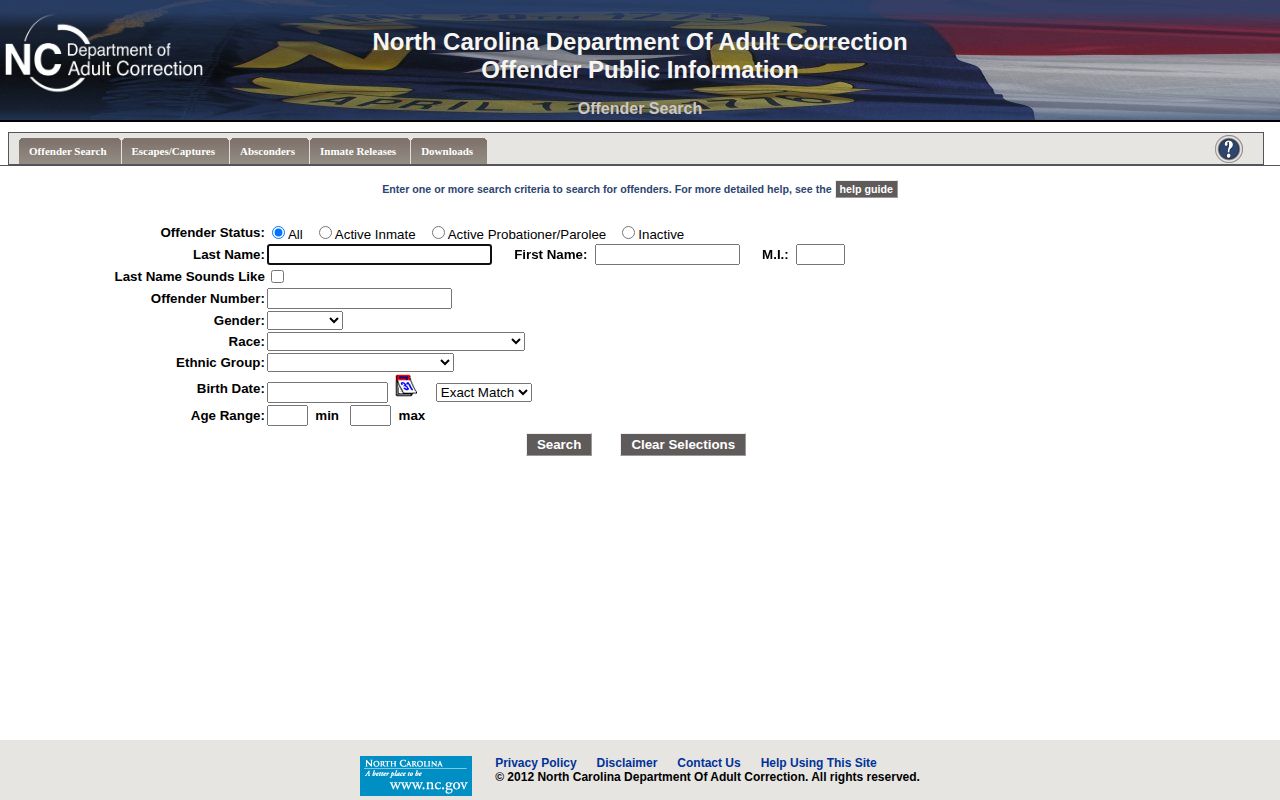
The locator can show state projected and actual dates, but a Cumberland jail-only record belongs with the sheriff and court.
NCDAC Date Fields for Cumberland Cases
An NCDAC record can show Incarceration Status, Current Status, Admission Date, Admitting Location, Control Status, Current Location, Previous Location, Projected Release Date, and Actual Release Date. Sentence history can add sentence number, commitment type, conviction county, service status, sentence begin date, minimum and maximum terms, parole dates, docket number, and offense information.
For a completed state term, an inactive inmate status, an Actual Release Date, and expired service status together provide stronger evidence than the projection alone. Even then, read the separate supervision status. The state Inmate Release Search can also find releases by release county, year, and month or surname, but its Cumberland selection is a state-prison release destination field, not a Cumberland County jail feed.
NCDAC Cumberland Release Search Results
NCDAC maintains a separate Inmate Release Search in addition to the general locator. It accepts a release county, year, and month, or a surname and initial surname characters with Soundex. Cumberland appears in the county selector alongside “Release County Not Reported” and “Released To Other State(s).” The year menu is a moving recent-year window, while older individual histories remain in the general search.
A live Cumberland query produced offender number, last, first, and middle name, release date, primary offense and qualifier, and type of release. Observed release types included EXPIRATION and PAROLE/RETURN TO PAR. These are state-prison results. The county choice is a release destination or reporting field and does not turn the tool into a list of people who just left Cumberland County Detention Center.
This distinction resolves a common date conflict. Cumberland may record the day a sentenced person transferred from the jail into NCDAC custody. The state release search may later record the day prison confinement ended and the person moved to the community or parole. Neither record should be relabeled as the other event.
North Carolina Minimum-Term Floor
North Carolina structured sentencing cannot accurately be summarized as a universal rule that every person serves 85 percent. G.S. 15A-1340.13(d) permits earned-time credits to reduce a felony maximum term, but not below the minimum imposed by the court. A structured-sentencing felony prisoner therefore serves the judicial minimum even when authorized credits reduce time above that floor.
G.S. 15A-1340.17 supplies paired minimum and maximum terms. Some long Class B1 through E terms use a maximum formula based on the minimum plus 20 percent, rounding, and additional months; certain reportable offenses use a different addition. Other classes use statutory tables. Offense class, offense type, the minimum, and the post-release component all matter.
Cumberland Prison Release and Supervision
G.S. 15A-1368.2 governs the move from state prison into post-release supervision. In general, a covered prisoner is released from prison on the maximum term less 12 months for Class B1 through E felonies or less nine months for Class F through I felonies, further reduced by applicable earned time. A qualifying reportable conviction can use a 60-month component.
Supervision generally lasts 12 months for B1 through E, nine months for F through I, or five years for an offense requiring registration. The prison-release date and sentence-termination date are therefore distinct. The Cumberland post-release supervision guide explains how to verify the separate status through NCDAC and District 12 contacts.
Cumberland Jail and State Earned Time
G.S. 148-13 directs NCDAC to set rules for earning and forfeiting credit. Authorized regulations also apply to sentenced local-jail prisoners. Credit can depend on behavior, work, study, programs, and forfeiture under the applicable rule, so an earlier projected date may later move.
For misdemeanor sentences, G.S. 15A-1340.20 says an activated sentence is served day for day subject to authorized work and earned-time credit. The combined award is capped at four days per month of incarceration. That rule can affect a locally sentenced person, but it does not apply to a pretrial bond release.
Note: Cumberland publishes no calculator or public county projected-date field, so named-person calculations should be confirmed by the responsible custodian.
Why Cumberland Release Dates Change
A current date can move for several independent reasons. The official record, not a hand calculation from the judgment, should control a current lookup.
| Factor | Possible effect |
|---|---|
| Earned credit | May reduce eligible time above the minimum floor |
| Disciplinary forfeiture | May remove credit and move a projection later |
| Concurrent or consecutive terms | Changes how multiple sentences combine |
| Jail credit | Applies qualifying prior confinement to the sentence |
| Court amendment or revocation | Can alter the governing term or custody status |
| Detainer or another jurisdiction's hold | Can change destination even when one sentence ends |
| Program or probation pickup | Can delay physical departure from Cumberland jail |
Cumberland County Discharge Timing
The Cumberland sheriff's release guidance says sentenced inmates are generally discharged between 6 a.m. and 9 p.m. on the discharge date unless the court directs otherwise. That is a processing window, not a public forecast for every person. Release-control staff review files comprehensively in the order received. Holds, transfer requirements, and a required pickup by probation, treatment, or another program can affect when and where the person leaves.
A person missing from the Active Inmate Lookup may have bonded out, completed a sentence, transferred to NCDAC, or moved to another agency. Request the booking/release sheet through CCSO Records Management for the actual Cumberland date, time, and disposition. A court order explains legal authority but may precede physical departure.
Cumberland Court Dates Are Not Release Dates
A hearing date, bond entry, judgment date, or release order can explain the legal process without recording the exact moment the jail door opens. Cumberland cases may be heard in the courtroom at the jail, the county courthouse, or another proper courtroom. The statewide Odyssey system provides a public case timeline, but its Portal is not the official record.
Use the Clerk for an official judgment or order and CCSO for the physical-release timestamp. Release-control staff review the full file in the order received. Another agency's hold, a program pickup, or a transfer can remain relevant after the court event. Subtracting sentence days from a judgment date is not a sound Cumberland release-date method.
Confirm the Cumberland Release Event
For a county case, pair the sheriff record with the Cumberland criminal case when the legal reason matters. For a state-prison case, compare the NCDAC projected field with the later actual field and supervision status. For prospective notice, the Cumberland VINE inmate check explains NC SAVAN registration and the transfer re-registration rule.
Do not independently calculate a named person's date from the judgment alone. Offense date, class, jail credit, consecutive or concurrent terms, revocation, disciplinary action, later court amendments, statutory changes, and post-release rules can alter the result. Use the current official field and ask the proper custodian to explain a conflict.
When a state date conflicts with a county record, first determine whether the entries describe different custody periods. Cumberland may transfer the person into state custody on one date, while NCDAC later records actual prison release on another. Both dates can be correct, but they answer different questions.
Public Record Search
Sponsored Results