
Cumberland Parole and Probation Compared
Probation usually follows a court judgment that permits supervision in the community instead of, or after, a period of confinement. Parole is conditional release before sentence expiration for a person eligible under the law that governs the offense. Most modern North Carolina felony sentences use structured sentencing and mandatory post-release supervision, not discretionary parole. The North Carolina Post-Release Supervision and Parole Commission sets post-release conditions and still decides parole for qualifying older-law cases.
| Status | How it begins | Public verification |
|---|---|---|
| Probation | Court judgment and supervision order | NCDAC probation/parole status and court case |
| Parole | Commission decision for an eligible sentence | NCDAC status plus published monthly decision data when applicable |
| Post-release supervision | Statutory transition after state prison | Separate NCDAC inmate and supervision fields |
Verify Cumberland Post-Release Supervision
The NCDAC Offender Public Information Search contains current and historical state-prison, probation, parole, and post-release information dating back to 1972. It excludes Cumberland County jail-only records. Use it to identify the correct person and read the supervision field as written.
- Search by name, adding date of birth or the seven-digit offender number when known.
- Choose Active Probationer/Parolee or search all statuses so an inactive prison record is not missed.
- Compare identifying details before relying on a result with a similar name.
- Read Inmate Status and Probation/Parole/Post Release Status separately.
- Review supervision and sentence dates, then confirm public office details through the state directory or Cumberland County number.
- If the person only left the county jail, request the sheriff release sheet and check the court case because NCDAC may have no record.
Note: A blank state search does not prove that Cumberland County custody ended or that no court-ordered supervision exists.
District 12 Cumberland Supervision Contacts
North Carolina Community Corrections Judicial District 12 covers Cumberland County. The county publishes direct numbers that provide a local verification route when a release involves continuing supervision, while the NCDAC office directory should be used to confirm the current assigned office. Officer assignments change, so no individual officer name should be treated as permanent.
Cumberland County supervision contacts
Probation: 910-486-1385
Day Reporting / Offender Rehabilitation: 910-323-6126
Pre-Trial Release / Electronic House Arrest: 910-677-5535
Pre-trial release is not probation or parole, even though it may impose monitoring while a case is pending. Day reporting can be part of a community correction plan. Ask which legal status and agency apply instead of using the terms interchangeably.
North Carolina Commission Records
The Post-Release Supervision and Parole Commission establishes conditions for structured-sentencing post-release cases and reviews the smaller group still eligible for discretionary parole. Its public contact is 2020 Yonkers Road, 4222 Mail Service Center, Raleigh, NC 27699-4222; 919-716-3010; fax 919-716-3987; Parole.Commission@dac.nc.gov.
The Commission does not ordinarily conduct formal, face-to-face offender hearings. Commissioners independently review files and vote, so no conventional docket-style public hearing calendar exists. A limited videoconference procedure for some people convicted as juveniles and sentenced to life with parole does not create a general public calendar. Monthly review and decision files, available from the Discretionary Parole Reviews page, begin with September 2024.
The official Commission page shown below is the responsible state source for its authority and contact information.
View the North Carolina Commission source page.
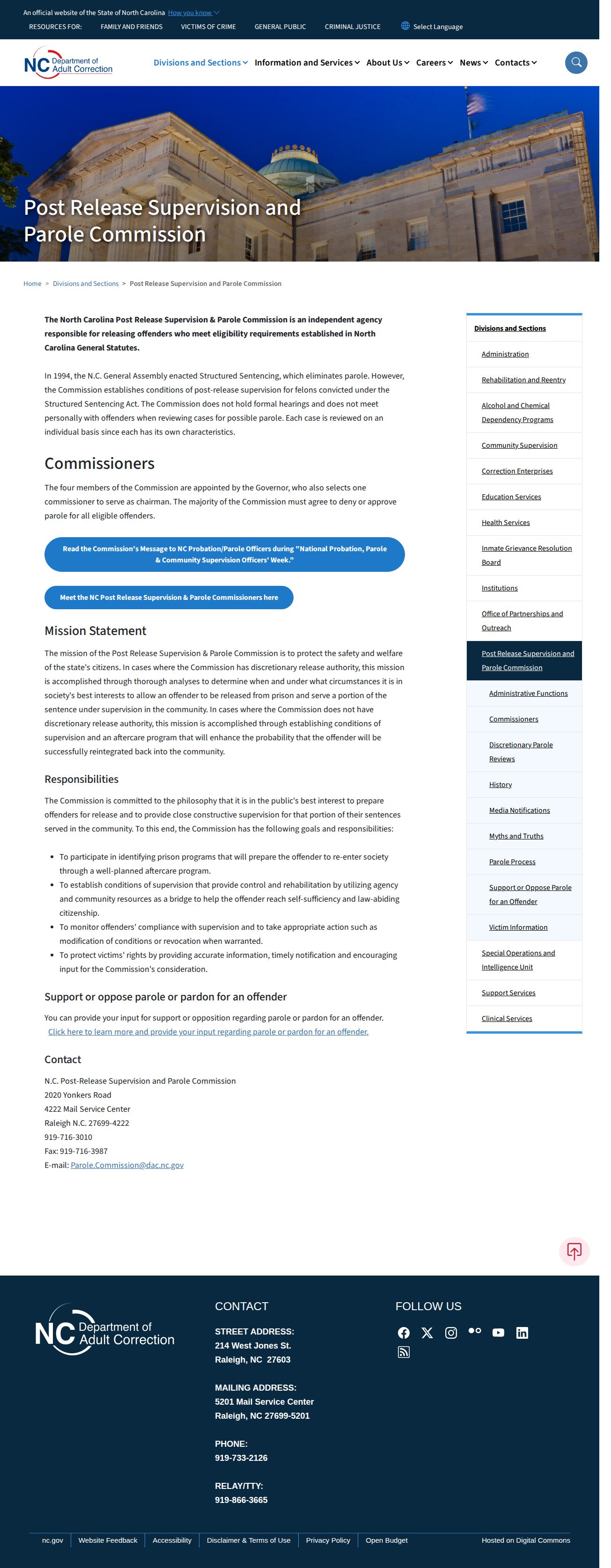
The image helps identify the state office, but a current individual status still belongs in the offender search and appropriate local record.
Cumberland Parole Review Outcomes
North Carolina's monthly data uses terms more precise than a simple granted or denied label. An Incomplete Decision means more information is needed and can include a psychological evaluation or a Mutual Agreement Parole Program investigation. A Suspend Decision stops further parole consideration at that time and can also record termination of a MAPP agreement after a program violation. Regular Parole is conditional release to supervision before sentence expiration after eligibility.
Community Service Parole, Early Medical Release, and 90-day Mandatory Parole are distinct mechanisms tied to qualifying circumstances or older offense dates. Regular parole generally concerns offenses committed before October 1, 1994. Modern structured-sentencing prisoners ordinarily move to mandatory post-release supervision. Under G.S. 15A-1371, eligibility and review depend on the governing sentence; one formula should not be applied to all cases.
Commission records are generally confidential. Monthly datasets are a limited public results trail, not access to complete files, victim submissions, evaluations, or commissioner deliberations.
Cumberland Parole Eligibility and Cadence
Parole eligibility depends on the offense date and the sentencing law that applies. Under G.S. 15A-1371, a covered sentence with a minimum term generally reaches eligibility after service of the minimum or one-fifth of the maximum statutory penalty, whichever is less, reduced by applicable credits. Older Fair Sentencing provisions contain their own rules for specified Class D through J felony prisoners. Those formulas should not be extended to a modern structured-sentencing case.
The Commission says eligible cases are reviewed at least once each year. First- or second-degree murder cases are generally reviewed every three years, except sexually violent offense cases reviewed every two years. A majority of commissioners must agree to approve or deny. The Commission also says there is no gubernatorial override and no ordinary appeal process. A monthly entry is the published state result, not a Cumberland court ruling.
G.S. 15A-1371(d) lists refusal grounds that include risk of noncompliance with conditions, depreciation of the offense's seriousness, a need for further correctional treatment, and risk of further criminal conduct. A denial row does not establish which ground applied unless the data identifies it. Public results must not be expanded into unsupported claims about confidential deliberations.
Cumberland Absconder and Warrant Checks
NCDAC defines an absconder as a person actively avoiding probation or parole supervision. The official OPI Absconder Search is the public state lookup. The state also accepts anonymous information at 888-646-0024. An absconder entry indicates a supervision and wanted status; it is not proof of a new conviction or current confinement.
The Cumberland County Sheriff's Office Fugitive Division enters warrants and orders in its PISTOL system and enters felony and serious-misdemeanor warrants or orders in DCI or NCIC. Its administrative number is 910-672-5660, Monday through Friday from 8 a.m. to 5 p.m.; the Watch Commander handles after-hours emergencies at 910-677-5432. The Fugitive/Warrants page does not provide a public list. Do not mistake that descriptive page for a searchable Cumberland absconder database.
Fayetteville-Cumberland Reentry Landscape
State material names a Fayetteville-Cumberland Reentry Council and maps Hoke Correctional Institution as the designated reentry facility for its catchment. That finding helps place local reentry planning in the state system, but the source publishes neither a council telephone number nor an eligibility or intake workflow. It should not be read as an automatic placement promise. The District 12 office and NCDAC remain the practical official routes for a specific supervision record.
Someone transported from Cumberland County Detention Center to NCDAC has not been released to the community. Someone leaving state prison may enter post-release supervision in Cumberland County, but the actual assigned district should be confirmed from the record. Those distinctions keep county jail release, state prison discharge, and community supervision in the right systems.
NC SAVAN can help follow a custody change because it connects jail, prison, probation, and parole information statewide. It is a notification layer, not the formal supervision record. After a transfer, the state instructs registrants to call and re-register against the receiving record. Use NCDAC and the assigned office for current supervision verification.
Property After Cumberland Jail Release
At booking, Cumberland detention staff inventory property and seal it in tamper-resistant bags; personal clothing is stored. At discharge, unused account funds, stored clothing, and other property held by the jail are returned. Questions about items held as evidence or retained by another agency may need to go to the arresting agency rather than Community Corrections.
Some releases to adult probation, drug treatment, or another program require pickup by a representative. The sheriff reviews release files in the order received, so a supervision plan or court event does not guarantee an immediate walk-out. The sheriff's Release Information page explains this local process.
When Cumberland Supervision Ends
Completion or discharge should be verified through the NCDAC supervision history and, where needed, the underlying court or Commission record. An actual prison release date only closes the documented confinement period. It does not by itself show that parole, probation, or post-release supervision has ended.
Detailed Community Supervision material, including officer notes, home contacts, violation investigations, and full case files, is confidential under G.S. 15-207. The public locator provides basic status and date information. For the broader county release record and the legal event behind release, use the Cumberland County released-inmate search and records guide. A federal release must be checked through the responsible federal system, while juvenile placement information follows confidential Juvenile Justice and court channels.
Public Record Search
Sponsored Results