
Cumberland Detention Center Release Paths
The Cumberland County Sheriff’s Office describes several ways county custody can end. “Release” on a local record is not one uniform outcome. It may mean the person entered the community, but it may instead record a handoff to a different custodian or program. The destination and disposition are as important as the departure time.
| Recorded path | What happens next |
|---|---|
| Bond or court order | The person may leave for the community after release-control review and any other holds are resolved. |
| Sentence completion | The local jail term ends, subject to the sheriff’s processing and any lawful pickup requirement. |
| Fine and costs paid | The payment can supply the basis for release when that is the applicable case outcome. |
| Program or probation pickup | Jail custody ends, but the person enters a supervised or treatment-related arrangement. |
| Another jurisdiction | Cumberland custody ends while confinement may continue under the receiving authority. |
| NCDAC transfer | A state-prison sentence continues through the North Carolina correctional system. |
A community outcome should be checked against the county release sheet and, when relevant, the Cumberland court case. A transfer must be followed in the receiving system. The Cumberland County released-inmate search guide explains that broader custody-trail method.
Confirm a Cumberland Detention Center Release
No official Cumberland recent-release archive was found. The reliable workflow starts with the active list only as a current-custody check, then moves to direct confirmation:
- Search the CCSO Active Inmate Lookup by first name, last name, and arrest date when known.
- If the person is absent, call the detention information desk or Booking/Release. Ask whether county custody ended and whether the disposition was community release or transfer.
- Request the existing booking/release sheet from CCSO Records Management. Include the name, arrest date, and booking number when available.
- If a court order caused the change, check the Cumberland case and seek the official order from the Clerk of Superior Court.
- If the record shows a transfer, use NCDAC or the named jurisdiction’s own custody system.
A missing active-roster result does not prove release because a transfer, timing difference, or another custody path can produce the same absence.
Cumberland Detention Center Release Control
Release-control officers comprehensively review the paperwork and other information in each file in the order received. A posted bond, judicial ruling, or teletype ending another agency’s hold can start the process, but none creates a guaranteed walk-out time. Staff must identify the legal authority, check remaining holds, and complete the local steps before physical departure.
The sheriff says releases can occur during the day or at night. People serving a sentence are generally discharged between 6 a.m. and 9 p.m. on the discharge date unless a court directs otherwise. Some people going to adult probation, drug treatment, or another program must be collected by a program representative. A release order therefore may precede actual departure.
The official CCSO Release Information page shows the county’s published release process and destinations.
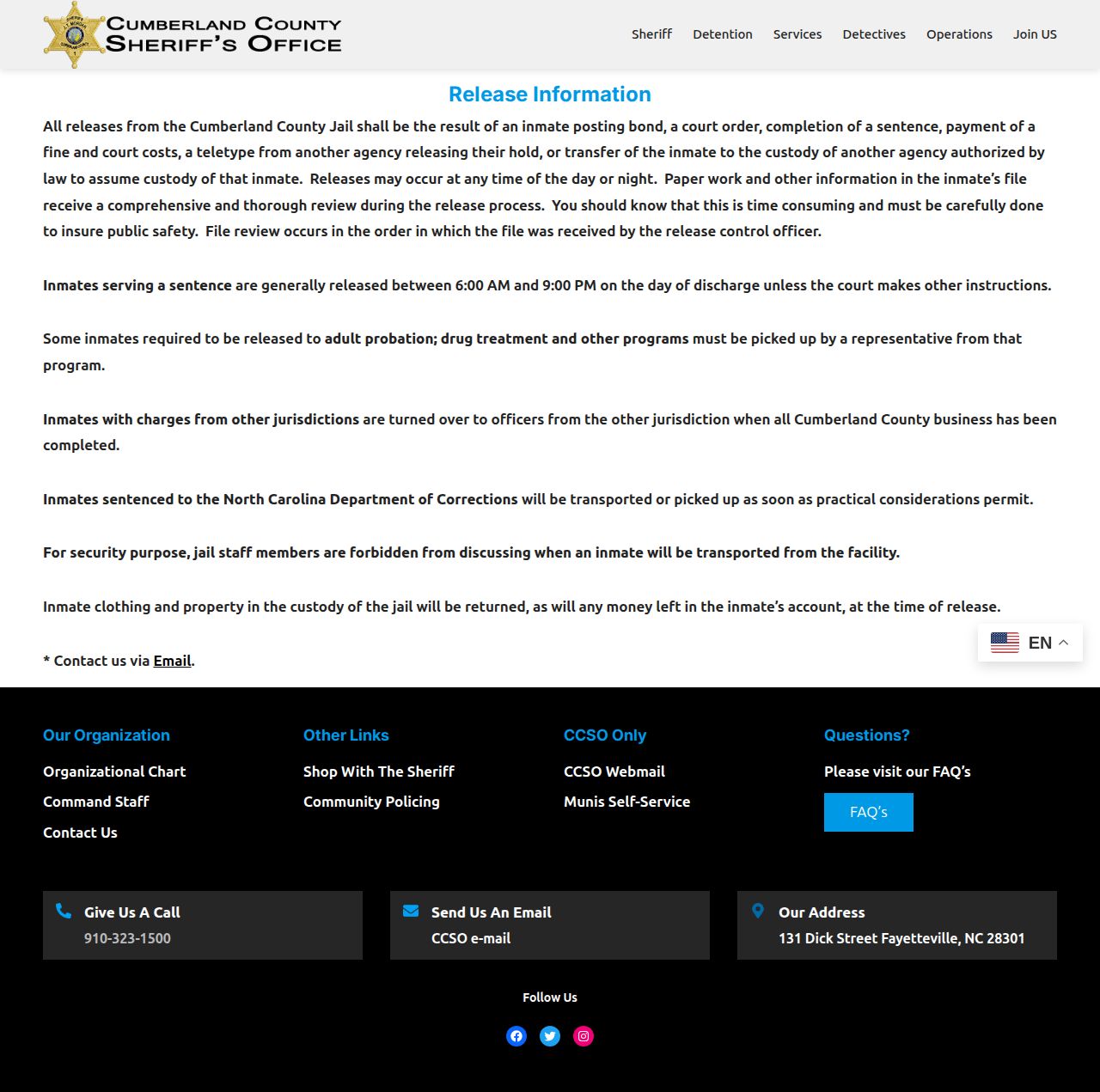
The published process supports asking for both the release time and the release disposition instead of assuming that every departure was an unconditional return to the community.
Cumberland Detention Center Release Contacts
Use the detention numbers for a current status question and Records Management for an existing document. The jail mail address and the sheriff’s records address serve different purposes.
Detention and Booking/Release
Cumberland County Detention Center
204 Gillespie Street
Fayetteville, NC 28301
Information: 910-672-5630 or 910-672-5622
Booking/Release administrator: 910-672-5701
Public magistrate: 910-672-5610
Sheriff main: 910-323-1500
CCSO Records Management
Mail: ATTN: Records Management, 131 Dick Street, Fayetteville, NC 28301
Main and 24-hour phone: 910-677-5414
Public hours: Monday through Friday, 8 a.m. to 5 p.m.
The Gillespie Street address is published for jail mail. A release-record request belongs with Records Management at Dick Street. No county fee schedule or fixed response period for a jail release sheet was identified, so ask the custodian about cost and timing.
Cumberland Detention Center Roster Limits
The public tool is titled the Cumberland Detention Center Active Inmate Search. Its fields are Arrest Date, First Name, and Last Name. The sheriff’s notice cites N.C.G.S. 132-1.4 and says the convenient online information is neither complete nor a substitute for an official source.
| Result | Careful reading |
|---|---|
| Name appears | The person is listed in current county custody, subject to the sheriff’s own data warning. |
| Name does not appear | Call and request the record; absence alone cannot distinguish release, transfer, or timing. |
| Court order appears in a case | The order can explain legal authority but not the jail’s exact departure time. |
| NCDAC record appears | The person has a state correctional record; it does not replace the county release sheet. |
There is no official 24-hour or 72-hour released-person feed in the reviewed sheriff navigation. The active tool must not be relabeled as a release list, and a date entered there is an arrest-date search field rather than a release-date filter.
Cumberland Detention Center Booking Process
Understanding intake helps explain why a quick release can still take time. The sheriff says pre-booking at the arresting agency can take four hours or more, while intake and booking at the jail can take four to eight hours. Staff perform a health assessment, identification and warrant checks, fingerprints and a photograph, data entry, a bail determination by a judicial official, and court-date setting.
Some people can qualify for release during intake. An intoxicated person may remain held until staff determine the person can be released safely. These are processing facts, not a timetable for any named person.
The sheriff’s Detention Center page presents the published booking steps and official contact lines.
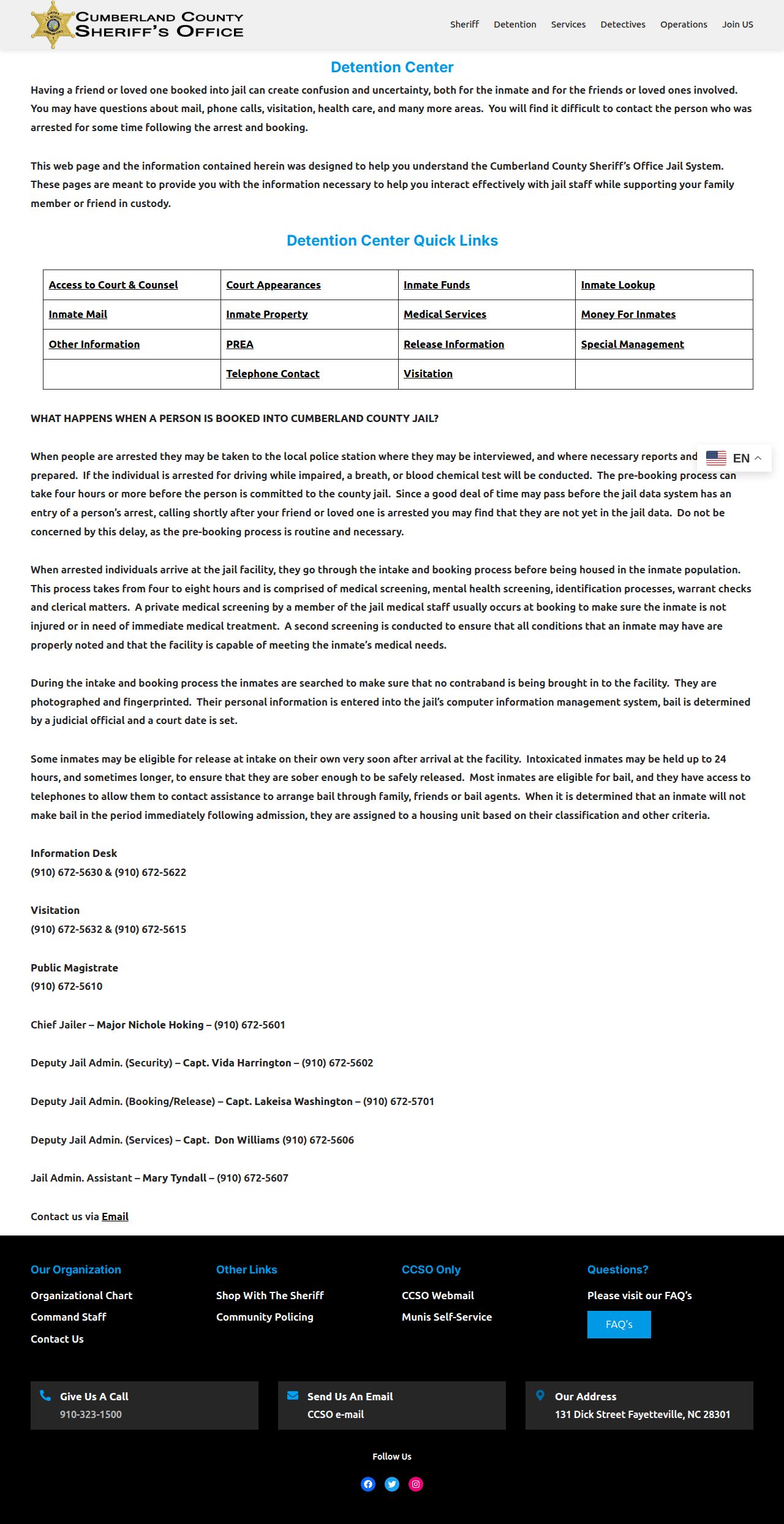
The jail page is useful for intake and direct contacts, while the separate release sheet remains the better evidence of when custody ended and where the person went.
Cumberland Detention Center Release Records
Ask Records Management for the jail booking/release record, not merely an incident report. A focused request should identify the person and seek the booking/release sheet, actual release date and time, and release disposition or destination. A booking photograph can be requested as a distinct existing record, subject to the custodian’s review.
Chapter 132 begins with a broad definition of North Carolina public records, but access remains subject to confidentiality laws and exemptions. G.S. 132-1.4 separates listed public arrest facts from protected investigative and intelligence material. G.S. 132-6 uses an “as promptly as possible” access standard, while G.S. 132-6.2 permits actual copy costs and, in some cases, a special service charge. Those laws do not justify promising that a release sheet is free or available within a set number of days.
Use only enough information to identify the record, such as the full name, arrest date, and booking number if known. The custodian may redact protected information or decline to disclose confidential material. A sealed or expunged record may also be absent from public access.
Cumberland Detention Center Transfer Records
A transfer ends Cumberland County jail custody but does not necessarily end confinement. If another county has pending charges, the sheriff may turn the person over after Cumberland matters are finished. A person sentenced to state prison can be transported or collected when practical. Staff do not disclose transport timing for security reasons.
For an NCDAC transfer, use the state Offender Public Information Search and compare identifiers carefully. NCDAC data includes state-prison, probation, and parole histories, not Cumberland-only jail stays. The relevant state fields can include Inmate Status, Probation/Parole/Post Release Status, current or prior locations, a Projected Release Date, and an Actual Release Date.
A program or probation pickup is different again. The person has left the jail, but legal or program duties may continue. For another-jurisdiction transfer, follow the named receiving agency. Do not describe “released by Cumberland County” as “free” unless the documented destination supports a community release.
Cumberland Detention Center Release Property
CCSO inventories property at booking and seals it in tamper-resistant bags. Personal clothing is stored. At discharge, the jail returns unused account funds, clothing, and property that remains in its custody. That process is separate from the legal record that authorizes release.
Questions about jail-stored clothing, account funds, or the sealed property inventory belong with detention staff. Property retained as evidence or held by an arresting agency may require contact with that agency instead. A property receipt can help identify the responsible custodian, but it does not prove the reason or exact time of release.
A person transferring to another custodian may have property handled according to the authorized transfer process. Do not infer a community return solely from the fact that Cumberland’s active listing ended or a local property step occurred.
Cumberland Detention Center Adult Record Boundary
This facility is the county’s adult booking and detention center. It is distinct from the state-operated Cumberland Juvenile Detention Center, whose placement and release information follows juvenile-court and Juvenile Justice confidentiality rules. Adult roster and booking-record instructions must not be used to seek protected juvenile information.
The same boundary applies in the other direction. A person moved to NCDAC is no longer in the county-jail lane, though the county release sheet should document the local handoff. Federal prison, federal pretrial, and immigration custody also have separate systems. Choose the next source from the documented disposition rather than searching every database as if they hold the same record.
Public Record Search
Sponsored Results